
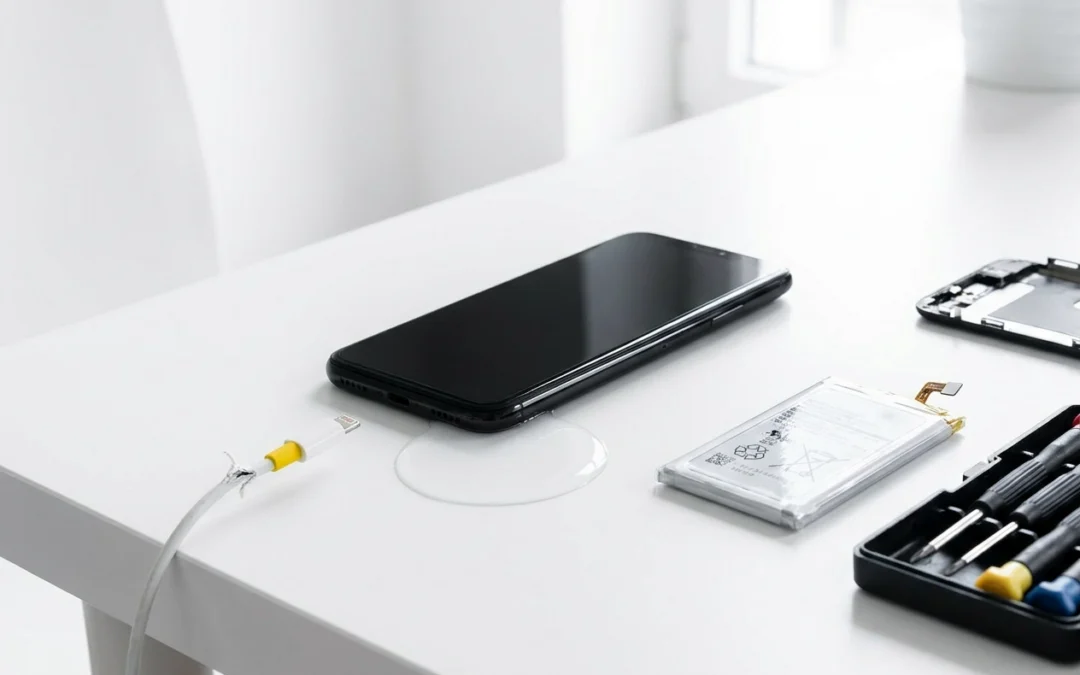
Your phone just took a swim, or maybe it stopped charging out of nowhere, and now you’re staring at a screen wondering whether to panic. Before you start pricing up a replacement, here’s something worth knowing: most people write off their phones far too quickly.
Can you repair a water damaged phone? In most cases, yes. Charging faults are often just as fixable. The outcome depends less on how bad things look right now and more on what you do next and who you ask for help.
This post is here to give you a clear-headed framework before you spend a single cent. You will learn what actually happens to a phone when it gets wet, what a free diagnosis can tell you, and how charging port problems are usually simpler than they seem. You will also get a practical way to weigh up repair costs against replacement costs, so you can make a decision based on facts rather than frustration.
The goal is simple: no more guessing, no more automatic write-offs. Just a realistic picture of your options.
Why Water Damage and Charging Faults Are Not Automatic Write-Offs
Drop your phone in water and the gut reaction is usually the same: it’s gone. That assumption is wrong more often than people realise, and acting on it too quickly can cost you a perfectly repairable device.
Many phones brought in for assessment after liquid exposure are fully recoverable, particularly when the owner gets the device to a technician quickly rather than leaving it sitting in a drawer for three days. Timing genuinely matters here, and the rest of this post explains why.
Charging faults are even more commonly misread. A phone that won’t charge is not necessarily dealing with serious internal damage. In a large number of cases the culprit is compacted lint in the port, light corrosion on the connector, or simple wear on the socket itself. All of those are fixable, often at modest cost.
What about IP ratings? Modern smartphones are more resilient than older models, and many carry IP67 or IP68 ratings. It’s worth knowing what those actually mean. An IP67 or IP68 rating is awarded under specific, controlled laboratory conditions: IP67 covers submersion to one metre for 30 minutes; IP68 allows manufacturer-defined depths. Neither rating accounts for running water pressure, saltwater, chlorinated pools, or the gradual wear of door seals over years of use. A rated phone that lets in water hasn’t necessarily failed, it may simply have encountered conditions outside the scope of its rating.
This is why a proper water damage and motherboard issue diagnosis matters before any money changes hands. The decision to repair or replace is rarely obvious from the outside. A diagnosis tells you exactly what you’re dealing with.
What Actually Happens When a Phone Gets Wet
So what is actually going wrong inside the device when it gets wet?
Water does not destroy a phone on contact. The immediate exposure is rarely the problem. The real damage builds over time through corrosion, as moisture reacts with the metal components on the circuit board, leaving behind mineral deposits and creating electrical faults that worsen the longer the phone sits untreated. Timing genuinely matters here.
Not all liquids are equal. Fresh water is the most forgiving. Salt water and seawater are significantly more destructive because salt acts as a conductor, accelerating the electrochemical corrosion process across the board. Sugary drinks and soft drinks are similarly aggressive, leaving behind sticky residues and dissolved minerals that continue reacting with internal components long after the liquid appears to have dried. If your phone went into the ocean or you spilled a soft drink on it, the recovery window is shorter.
The most damaging thing you can do is turn it on. Applying power to a wet phone sends current through moisture that is still sitting on the board, which can cause short circuits and compound the damage immediately. Do not charge it either. Turn it off if it is still running, leave it off, skip the hair dryer (heat can drive moisture deeper into components), and get it to a technician as quickly as you can.
About the rice trick. Placing your phone in a bag of rice is widely shared advice that does not hold up. Rice absorbs very little moisture from inside a sealed device, and the time you spend waiting is time that corrosion is progressing unchecked. It is not a treatment; it is a delay that reduces your chances of a successful repair.
Can You Actually Repair a Water Damaged Phone? What the Diagnosis Reveals
So the real question isn’t whether water-damaged phones can be repaired. Most can. The outcome depends on three things: how much corrosion has formed, which components were affected, and how quickly the phone was assessed after exposure.
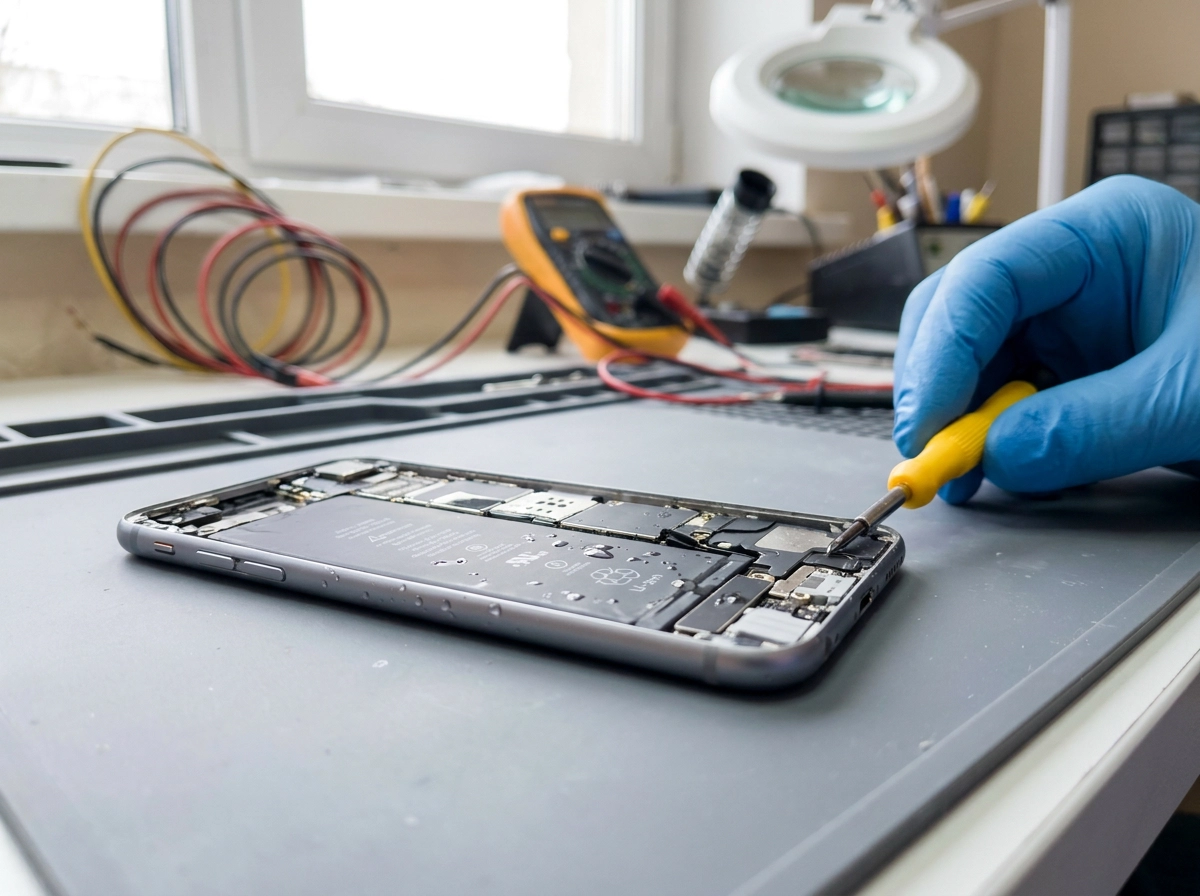
A proper water damage and motherboard issue diagnosis should cover more than a quick visual once-over. A technician should inspect internal components directly, check the logic board for corrosion, identify which individual parts have been compromised, and give you an honest prognosis. That last part matters. An honest “this isn’t worth fixing” is as valuable as a successful repair quote.
A diagnosis is not a repair. Nothing is opened up and worked on without your say-so. The point is to understand exactly what you’re dealing with before any money changes hands or any work begins.
What technicians typically find falls into a few broad categories:
- Isolated port or speaker corrosion: highly repairable, often straightforward
- Light corrosion on the logic board: usually treatable with professional cleaning
- Widespread board damage across multiple components: lower success rate, higher cost, and sometimes not worth pursuing
Timing shapes which category your phone falls into. Plugging in a wet phone accelerates corrosion through electrolysis, destroying board components in seconds rather than hours. On the Gold Coast, where humidity stays high year-round, corrosion that might develop slowly elsewhere progresses faster. Hours matter far more than most people realise, which is why getting a diagnosis the same day is always the better move.
Charging Port Problems: Usually Simpler Than They Look
Not every charging fault is as serious as it first seems. While water damage often involves complex internal assessment, charging port problems are frequently the most straightforward repair job in the shop.
The single most common reason a phone stops charging is compacted lint or debris packed into the port. Phones carried in pockets or bags accumulate fluff over time, and eventually the cable simply cannot make a proper connection. A careful clean by a technician often resolves the issue entirely, sometimes at no cost at all. It is worth ruling this out before assuming anything is broken.
When the port itself does need replacing, it is typically a manageable repair for most iPhone, Samsung, OPPO and Google Pixel models where parts are available. It is not the complex job many people fear.
A few signs that point to the port rather than the battery or software:
- The phone charges intermittently, or only at a specific angle
- The cable sits loosely rather than clicking in firmly
- There is no charging response at all, even with a known-working cable
- Wireless charging still works, but wired charging does not
If you are seeing those last two symptoms together, it is worth also checking whether a professional battery replacement might be the actual issue before assuming the port is at fault.
One more thing worth knowing: water damage and charging port faults overlap more often than people expect. Corrosion inside the port is one of the most frequent outcomes of liquid exposure, and it is often what quietly kills charging functionality days or weeks after a wet incident, well after the phone appears to have dried out fine.
The Repair vs. Replace Decision: A Realistic Framework
So you’ve got a diagnosis in hand and a repair cost in front of you. The real question now isn’t whether the phone can be fixed. It’s whether fixing it actually makes financial sense.
A useful rule of thumb: if the repair cost is less than half what you’d pay for an equivalent replacement device, repair is almost always the better call. It’s a simple benchmark, but it holds up well in practice.
Device age changes the calculation significantly. A two-year-old flagship with recoverable water damage is worth repairing; the device still has real value and likely several years of useful life ahead. A five-year-old entry-level phone with extensive board corrosion is a different story. The repair cost can quickly approach or exceed what the phone is actually worth.
For common faults, mobile repair can be genuinely cost-effective compared to buying new. A port clean, a port replacement or a targeted water damage treatment on a well-maintained phone is often far cheaper than people expect, and a fraction of the cost of a new device.
When repair genuinely isn’t the right call, a quality refurbished phone with a warranty is usually a smarter move than buying new at full retail. HocoTech stocks refurbished devices in Coolangatta, with more available through our supplier network. If you’re not sure what to look for, understanding what ‘refurbished’ actually means before you buy is worth a few minutes of your time. You can also browse available refurbished models to see what’s in stock.
One final thing worth separating from the financial question: your data. Photos, contacts and app data can sometimes be recovered even from phones that aren’t worth repairing as functional devices. If your phone holds irreplaceable memories, ask about data recovery as a standalone option before writing it off entirely.
When Repair Genuinely Is Not Worth Pursuing
Sometimes the honest answer is that a repair is not the right call. That is worth knowing upfront, because it shapes every decision that follows.
The clearest case is extensive corrosion across multiple logic board components. The logic board is the brain of the phone, and when corrosion spreads to several areas of it, the cost of micro-soldering or component replacement quickly outpaces what the device is actually worth, particularly on older or budget-tier phones.
How long the phone sat wet matters enormously. A phone submerged briefly and assessed within hours has a very different prognosis to one that was left in a wet bag for three days. Corrosion accelerates over time, and by the time some phones come in for assessment, the damage is simply too widespread to address cost-effectively.
Pre-existing damage compounds the problem. A phone already running with a cracked screen, a history of liquid exposure, or a swollen battery is starting from a weaker position. Repair success rates are lower, and the cost-to-value ratio rarely works in the owner’s favour.
A reputable technician will tell you this plainly, before charging you anything. If a shop pushes ahead with expensive work without giving you a clear diagnosis and an upfront quote first, that is a red flag worth taking seriously.
The phone being unsalvageable does not mean the situation is a total loss. Data recovery may still be possible. Components can sometimes be salvaged. And most devices, regardless of condition, can be traded in or recycled responsibly rather than simply thrown away. It is always worth having that conversation.
What to Expect When You Take Your Phone In for Repair
So you’ve got a clear picture of what a repair can and can’t achieve. The next question is practical: what does the actual process look like when you walk through the door?
A good repair experience starts with a free initial assessment. A technician should look at the device, explain what they’ve found in plain language, and give you an upfront quote before any work begins. If repair isn’t the right call, they should say so honestly rather than push ahead regardless.
Turnaround times depend on the fault. A port clean or straightforward port replacement is typically a same-day job. Water damage treatment can take longer, depending on how much corrosion is present and which components are affected.
A few questions worth asking at the counter:
- What does the diagnosis actually cover?
- Will I get a quote before any work starts?
- What warranty applies to the repair?
- What happens if the same fault comes back?
If getting to a shop is difficult, particularly if your phone is your only means of navigation, HocoTech’s Come-to-You service brings repairs to customers across Coolangatta, Tweed Heads and the surrounding southern Gold Coast area. You can find out more about the full range of services at Mobile Phone Repairs & Accessories in Coolangatta.
Repairs are available for Apple iPhone, Samsung, OPPO, Google Pixel, Motorola and Nothing Phone devices where parts are available. Parts availability for less common models can vary, so it’s worth checking before you assume your device is covered.
The Bottom Line: Get a Diagnosis Before You Write It Off
Most water-damaged phones and charging faults are diagnosable problems with realistic repair options, not automatic write-offs. The outcome depends on two things above all else: how quickly you act, and whether you get a proper assessment before spending any money.
If your phone just got wet, the most important step is also the simplest. Power it off, do not attempt to charge it, and get it assessed as soon as possible. Every hour counts once corrosion starts.
Three things worth remembering before you do anything else:
- Do not charge a wet phone. It is one of the most common mistakes and can turn a recoverable situation into permanent damage.
- Do not leave it sitting for days. Corrosion does not wait, especially in a humid climate like the Gold Coast.
- Get a clear quote before any repair work begins. A diagnosis should always come first, with no obligation to proceed.
HocoTech in Coolangatta offers free diagnosis for water damage and charging faults. Whether you are in Coolangatta, Tweed Heads or anywhere in the southern Gold Coast area, you are welcome to come in, call, or enquire online before committing to anything.
And if the diagnosis finds that repair genuinely is not the right call, that is not the end of the road. A quality refurbished phone with a one-year in-store warranty is a practical, cost-effective alternative available in store. You leave with a working device, proper warranty cover, and no regrets about throwing money at something that was not worth saving.
Conclusion
Water damage and charging port faults are rarely the end of the story. The key lessons from this guide come down to a few straightforward principles: act fast, avoid charging a wet device, and always get a proper diagnosis before writing anything off. Most charging issues are simpler and cheaper to fix than people expect, and even genuine water damage can be recoverable when addressed early.
The decision to repair or replace should be based on facts, not assumptions. A free diagnosis gives you exactly that, with no pressure and no upfront cost.
If your phone has taken a dunking or stopped charging, do not leave it sitting on the bench. Bring it in, get the facts, and make a decision you can feel confident about. The worst outcome is always the one you never bothered to investigate.
Frequently Asked Questions
Can a water-damaged phone actually be repaired, or should I just buy a new one?
Most water-damaged phones can be repaired successfully, especially if you act quickly. The outcome depends on three key factors: how much corrosion has formed, which components were affected, and how quickly the phone was assessed after water exposure. A proper diagnosis from a technician will tell you exactly what you're dealing with before any money changes hands. As a general rule, if the repair cost is less than half what you'd pay for a replacement device, repair is almost always the better financial choice.
What should I do immediately after my phone gets wet?
The most critical steps are: (1) Power it off immediately if it's still running, (2) Do NOT charge it or attempt to turn it on—applying power to a wet phone can cause short circuits and compound damage instantly, (3) Do NOT use a hair dryer or place it in rice—heat drives moisture deeper and rice delays treatment without preventing corrosion, and (4) Get it to a technician as quickly as possible. Every hour counts because corrosion accelerates over time, especially in humid climates like the Gold Coast. Timing genuinely matters more than most people realise.
Why won't my phone charge, and is it always serious damage?
Most charging faults are actually simpler than they appear and don't indicate serious internal damage. The most common culprit is compacted lint or debris packed into the charging port, which can often be resolved with a careful professional clean—sometimes at no cost at all. Other frequent causes include light corrosion on the connector or simple wear on the socket itself—all fixable at modest cost. Signs pointing to a port issue include intermittent charging, the cable sitting loosely, or the phone charging only at a specific angle. It's worth having a technician check before assuming expensive repairs are needed.
What's the difference between saltwater damage and freshwater damage?
Not all liquids are equally damaging to phones. Fresh water is the most forgiving and allows the longest recovery window. Saltwater and seawater are significantly more destructive because salt acts as a conductor, accelerating the electrochemical corrosion process across the phone's components. Sugary drinks and soft drinks are similarly aggressive, leaving sticky residues and dissolved minerals that continue corroding internal parts long after appearing to have dried. If your phone was exposed to saltwater or sugary liquids, the recovery window is shorter, making it even more critical to seek professional assessment immediately.
How do I know when repair makes financial sense versus buying a replacement?
Use this practical rule of thumb: if the repair cost is less than half what you'd pay for an equivalent replacement device, repair is almost always the better choice. Device age also matters significantly—a two-year-old flagship with recoverable water damage is worth repairing since it still has real value and several years of useful life ahead, while a five-year-old entry-level phone with extensive board corrosion may not be worth the cost. Always get a clear quote from a technician before deciding. If repair isn't the right call, consider a quality refurbished phone with a warranty as a more cost-effective alternative to buying new at full retail.