You just dropped your phone. Heart in your throat, you flip it over and breathe a sigh of relief. But how long will that luck last?
If you’ve been putting off getting a screen protector because you’re not sure which type is actually worth buying, you’re not alone. The choice between a tempered glass screen protector and a plain plastic film is one of the most common questions phone owners ask, and the answer isn’t always obvious when you’re staring at a shelf full of options.
The good news is that this post cuts through the confusion. You’ll learn exactly what each type of protector does, how they stack up against each other in real-world use, and which one suits your lifestyle and budget. You’ll also find out why fit and installation matter just as much as the material itself, and what screen guard options HocoTech stocks for popular devices like iPhone, Samsung Galaxy, and Google Pixel.
By the end, you won’t need to do any more research. You’ll just need to pick the right one and order it.
What Is a Screen Protector and Why Does It Matter?
A screen protector does one simple job: it takes the hits so your actual display doesn’t have to. Scratches from keys, scuffs from sand, the occasional face-down drop on concrete, a good protector absorbs that daily punishment as a replaceable layer sitting in front of your phone’s screen.
Modern displays are genuinely tougher than they used to be. Corning Gorilla Glass 6 is engineered to survive multiple drops onto rough surfaces, and ceramic shield variants push durability further. But tougher doesn’t mean indestructible. Keys in a pocket, beach sand, or a single bad drop at the wrong angle can still crack or deeply scratch even a premium display.
That matters because screen repairs aren’t cheap. A protector is a sensible small purchase that can save you from a far more expensive repair down the track.
Two main types dominate the market: tempered glass and plastic film. This piece compares both honestly so you can make a straightforward call.
If you’re on the Gold Coast, there’s one more thing worth knowing. UV exposure, salt air, sand, and humidity are everyday realities here, and all of them can contribute to edge lifting over time. That local context comes up throughout this comparison. You can also find screen guard and strength case options at HocoTech in Coolangatta to suit your device and lifestyle.
What Is a Tempered Glass Screen Protector?
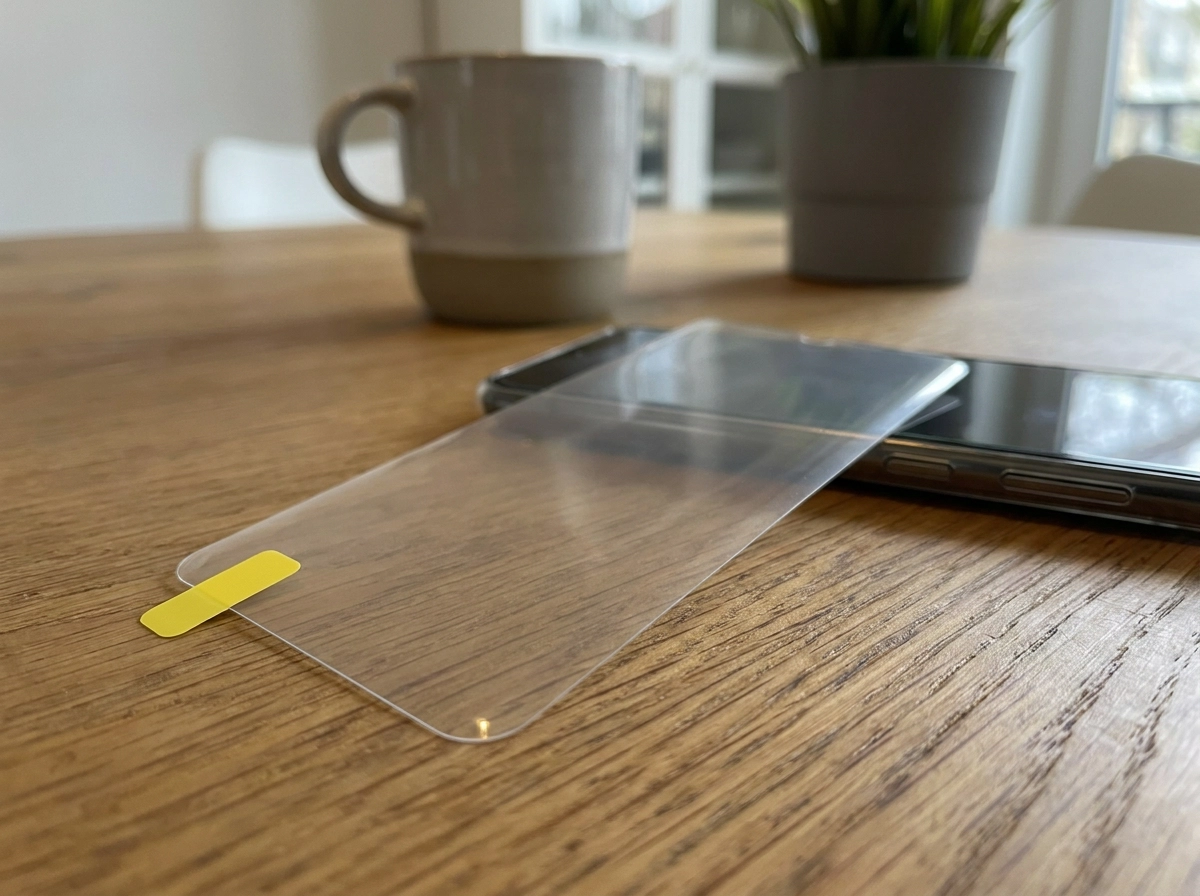
Tempered glass screen protectors start life as ordinary glass, which is then heated to extremely high temperatures and rapidly cooled. This process, called tempering, fundamentally changes the structure of the glass, making it significantly harder and more resistant to shattering than untreated glass.
The finished product is a thin, rigid layer with three key components: a glass surface, an adhesive underside that bonds to your phone screen, and an oleophobic coating on top. That outer coating is what repels fingerprint oils and keeps smears from building up during normal use.
Hardness is where tempered glass really earns its place. Most tempered glass screen protectors carry a 9H pencil hardness rating, a commercial rating indicating strong scratch resistance, though it is not a direct Mohs scale measurement. Steel, which is what keys and coins are made from, rates around 6.5 on the Mohs hardness scale. In practical terms, that means your keys rattling around in the same pocket as your phone are unlikely to leave a mark on a 9H-rated protector.
Impact protection works differently to scratch resistance. When your phone drops, tempered glass spreads the force across its surface rather than letting it concentrate on one point. Often the protector itself will crack or chip while the actual display underneath stays intact. That is the design working as intended.
Most tempered glass protectors are noticeably thinner than a fingernail. Within that range, quality varies considerably. A poorly cut protector that does not match your exact device model, or one with weak adhesive, will underperform regardless of the glass quality itself.
What Is a Plastic Film Screen Protector?
Plastic film protectors are the thinner, lighter alternative to tempered glass, and they work quite differently.
Most plastic film options are made from PET (polyethylene terephthalate), a flexible thermoplastic used in everything from drink bottles to packaging film. The more premium variant is TPU (thermoplastic polyurethane), which is softer and more elastic. Some TPU products are marketed as having a self-healing quality for very light surface marks, though this varies by product. Neither material comes close to the hardness of tempered glass.
Plastic film protectors are extremely thin, making them nearly invisible on the screen and having almost no impact on how the display looks or feels under your finger. If you genuinely cannot stand any added thickness, film is the obvious choice.
The honest trade-off is protection. Plastic film handles soft contact reasonably well, but keys, coins, sand grains and similar harder materials will scratch it without much effort. On the Gold Coast, where sand gets into everything, that matters.
Impact resistance is the bigger limitation. Rather than distributing force across the surface the way tempered glass does, plastic film simply flexes on impact. That flex does very little to protect the actual screen beneath it during a drop.
Adhesion is also worth considering locally. Plastic film protectors tend to lift at the edges over time, and the warm, humid conditions common across the Gold Coast and Tweed Heads region can contribute to edge lifting over time. Once the edges start peeling, dust and debris work their way underneath and the protector becomes more of a problem than a solution.
Tempered Glass vs. Plastic Film: A Straight Comparison
Now that you know what each material does on its own, here is how they stack up head-to-head across the things that matter most.
Scratch resistance is where the gap is most obvious. Tempered glass, rated 9H under standard pencil hardness testing (a commercial rating, not a direct Mohs measurement), shrugs off keys, coins and sand grains that would immediately mark a plastic film. Plastic film holds up against fingernails and soft contact, but not much else.
Impact protection follows the same pattern. As covered above, glass cracks to protect; film merely flexes.
Thickness and feel is the one area where plastic film has a genuine edge. It sits almost invisibly on the screen. Tempered glass adds a little more depth, though most users barely notice it in daily use, and some actually prefer the firmer feel it gives to swipes and taps.
Clarity and touch sensitivity are broadly equal with quality products, but budget plastic film can create a slightly hazy look or a sticky drag when scrolling. A well-made tempered glass screen protector keeps things crisp and responsive.
Adhesion and longevity is worth paying attention to in this part of the world. The warm, humid and often sandy conditions along the Gold Coast can contribute to edge lifting in plastic film protectors. Tempered glass with a quality adhesive layer holds flat significantly longer.
Price is the final point. Tempered glass costs a little more upfront, but given how much longer it lasts, it works out better value for most people.
Which Screen Protector Is Right for You?
For most people, tempered glass is the right call. It offers meaningfully better scratch and impact protection for a modest price difference, and that verdict holds whether you’re on an iPhone, Samsung, OPPO, Google Pixel, Motorola or Nothing Phone.
Plastic film does have a genuine use case. If your phone has a curved-edge screen where tempered glass doesn’t sit flush, or you simply want the thinnest, least-visible option and you’re comfortable accepting lower impact protection, film is a reasonable choice. Just go in with clear expectations.
Device-specific fit, precise dimensions, correct cutouts, is the single biggest factor separating a protector that works from one that doesn’t.
If you’re spending time outdoors on the Gold Coast, this decision becomes even more straightforward. Sand, salt water and sunscreen are genuinely harsh on phone screens, and tempered glass is generally considered the more durable choice in harsh outdoor conditions.
Finally, think of your protector and case as a system rather than separate accessories. A quality tempered glass protector paired with a screen guard, strength case that wraps the edges gives you the most complete everyday protection, covering the screen from direct contact and the frame from drops.
Why Fit and Installation Matter as Much as the Protector Itself
Choosing the right protector is only half the job. Even a quality tempered glass screen protector won’t do its job properly if it’s misaligned, sitting on a dust speck, or lifting at the edges.
The most common DIY mistakes are predictable. Dust trapped under the protector is the biggest culprit, creating visible halos that no amount of smoothing will fix. Misalignment on the first press is almost impossible to correct with tempered glass once it’s down. Bubbles that won’t clear usually mean dust, not air. Edge lifting often comes down to applying pressure at the wrong angle during those final few millimetres.
Device-specific protectors make all of this considerably easier. A protector cut precisely for your exact model comes with the right dimensions, pre-aligned cutouts for the camera and sensors, and often an alignment guide in the box. Generic or universal-fit options leave more room for error and rarely sit as flat or secure.
If the DIY process sounds frustrating, that’s because it often is. At HocoTech in Coolangatta, the team can fit your screen protector in-store, which is particularly useful if you want it done right the first time or if you’ve just had a screen repaired and want to protect it immediately.
Combining a screen protector fitting with a screen repair or battery replacement at HocoTech is a practical pairing. It saves a separate trip and means your phone leaves the store protected from the moment the repair is complete.
Screen Guard Protectors at HocoTech: What We Stock and Who It Suits
If you’ve decided device-specific fit is what you’re after, the good news is that’s exactly what HocoTech stocks.
At the Coolangatta store, screen guard protectors are available for a range of popular models, including iPhone and Samsung Galaxy devices, as well as other phones commonly repaired and sold in-store. Stock is model-specific rather than generic, so you’re getting a protector cut for your exact device rather than a close-enough approximation that may lift at the edges or leave gaps near the camera cutout.
Not sure which model you have? That’s more common than you’d think. The team can help identify your device and point you to the right phone screen protector, saving you the frustration of guessing and getting it wrong.
Screen protectors sit alongside HocoTech’s broader accessories range, including cases, chargers and cables, so if you want a complete protection setup it’s all in one place rather than spread across multiple stops.
If you’re picking up one of HocoTech’s refurbished smartphones, adding a screen protector at the same time is a straightforward first step. The phones come ready to use, and fitting a screen guard protector before the device goes into daily use means the screen stays in the condition you received it. You can browse available refurbished models, and if you don’t spot yours, check whether your preferred phone is in the wider range through the supplier network.
What If Your Screen Is Already Cracked or Scratched?
If you’re reading this after already dropping your phone, you’re not alone, and a screen protector isn’t the answer yet.
Sticking a protector over a cracked screen won’t fix the damage. It might hold the glass together temporarily, but the screen underneath is already compromised. The right move is to get the screen properly repaired first.
HocoTech repairs and replaces screens for iPhone, Samsung, OPPO, Google Pixel, Motorola and Nothing Phone devices at the Coolangatta workshop. If you can’t make it in, the Come-to-You repair service covers customers in Coolangatta, Tweed Heads and the surrounding southern Gold Coast and northern NSW areas.
Don’t wait for the damage to spread. A cracked screen can worsen quickly, and small cracks have a habit of reaching the display layer faster than expected.
Get in touch to find out whether your device is supported and to get a repair quote.
The Verdict: Go Tempered Glass for Most Phones
For most phone owners, the answer is straightforward: a device-specific tempered glass screen protector is worth the small price premium over plastic film. The difference in scratch and impact protection is real, and for everyday use across iPhone, Samsung, OPPO, Google Pixel, Motorola and Nothing Phone devices, tempered glass is simply the better investment.
HocoTech in Coolangatta stocks screen guard protectors for popular models, cut to fit specific devices rather than generic approximations. The team can help you find the right option for your phone and fit it properly while you wait.
If you are ready to protect your screen, or you need a repair before you do, drop into the store in Coolangatta, give us a call, or get in touch online. We are happy to point you in the right direction.
Conclusion
Choosing the right screen protector does not have to be complicated. Tempered glass, properly fitted to your specific device, is the clearest way to protect your investment.
The team at HocoTech in Coolangatta stocks screen protectors cut to fit your specific device and can install them properly while you wait. Drop in, call us, or get in touch online. Your screen is worth protecting, so start today.